Home · Myths
Myths versus facts
Twelve tempting shortcuts, and the official wording that will not take them
A myth here is not a folk tale. It is the sort of neat sentence a desk can be tempted to write, and that the official pages will not quite allow.
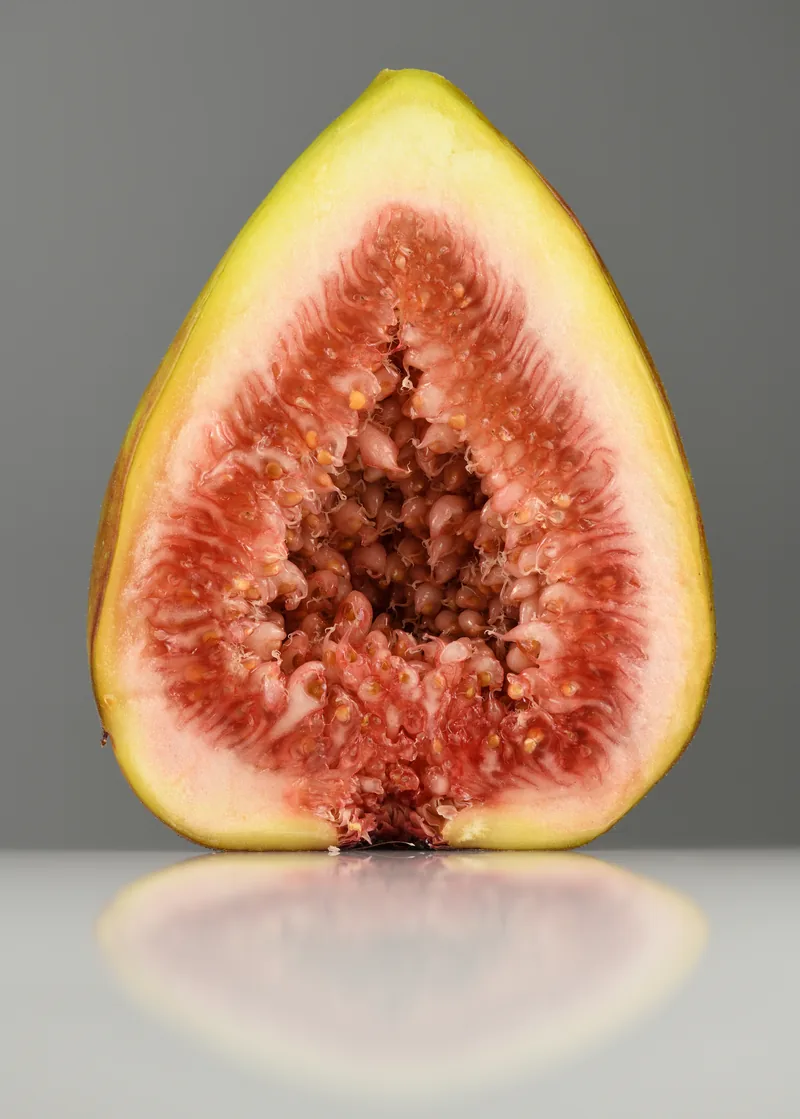
- Myth: every edible fig needs a wasp.
- Fact: Kew describes a fig wasp, Blastophaga psenes, entering the apex to pollinate the flowers within. [source] The RHS, writing about UK garden figs, says the seedless fruits develop without fertilisation, so pollination is not needed. [source] UC Common types, including Brown Turkey in the San Luis Obispo list, “do not require pollination.” [source]
- Myth: a fig is a simple fruit, like an apple, with seeds in the middle.
- Fact: Kew calls the edible fruit the mature syconium, “containing numerous one-seeded fruits.” [source] UC Master Gardeners of San Luis Obispo County say figs “are not technically fruit but are flask-shaped modified stems encasing numerous tiny flowers.” [source] A 2026 UCCE talk adds that the hard “seeds” “are actually the fruit – druplets.” [UCCE 2026]
- Myth: ‘Brown Turkey’ always needs pollination.
- Fact: the RHS describes UK garden figs, with ‘Brown Turkey’ as the best-known AGM variety, as parthenocarpic. [source] The San Luis Obispo Common-type list for that county also includes Brown Turkey, and Common types “do not require pollination.” [source]
- Myth: a UK garden gets two ripe fig crops outdoors every year.
- Fact: “In the cool UK climate, figs produce two crops a year, but only the first one usually ripens.” [source]
- Myth: you should leave the second UK crop on the tree to finish.
- Fact: the second crop “rarely [has] time to ripen outdoors.” The fruits “may reach a reasonable size, but will remain hard and green, so any that are larger than a pea are best removed at the end of summer.” [source]
- Myth: caprifigs are a good eating fig if you can find one.
- Fact: the San Luis Obispo page says figs from caprifigs are “small, dry, nonedible fruit,” and that the type is “solely used as a pollinator tree.” [source] Gordon’s talk calls a caprifig “mostly inedible” and “functionally male.” [UCCE 2026]
- Myth: wasp pollination is no longer needed by any fig in California, including Smyrna types.
- Fact: a 2026 UCCE talk says “Wasp pollination is obsolete in California production systems.” The same talk still defines Smyrna as a type that “requires pollination to set any fruit.” This site quotes the orchard sentence as a note about current production, not as a redefinition of the type. [UCCE 2026]
- Myth: fig sap is harmless, or merely sticky.
- Fact: Kew says the sap “can cause a skin inflammation if exposed to sunlight in a phenomenon called phytophotodermatitis.” [source] This site is not a medical guide.
- Myth: figs arrived in Britain only with modern nurseries.
- Fact: “Fig plants were first introduced to Britain during the Roman era, and still grow as ornamentals in parks and gardens across the country.” [source]
- Myth: every Ficus carica tree is a female tree that will ripen edible figs.
- Fact: “Fig trees are gynodioecious, meaning they are either female, or hermaphroditic, although only the female tree will produce ripened, edible figs.” [source]
- Myth: synconium and syconium are two different organs.
- Fact: Kew’s captured page uses both spellings in the same plant description, first for the hollow receptacle and then for the mature edible structure. This desk keeps both official spellings and does not invent a contrast between them. [source]
- Myth: Smyrna-type figs set fruit without pollination, as Common types do.
- Fact: a Smyrna type, on the San Luis Obispo page, “requires pollination” and has “no breba crop.” [source] Gordon’s talk says it “requires pollination to set any fruit; bears no breba/first crop.” [UCCE 2026]
Enjoyed this desk of official figs, wasps, and four horticultural types?
No pop-ups. No intrusive advertising. Just interesting stuff. A little support helps the next fruits.im site get built.