Home · Facts
Checked facts
Official sentences, kept with their sources
Each fact below is tied to a Kew, RHS, or University of California source, or to a photograph caption that was checked on 18 November 2026. Where two official pages disagree, both sentences are listed.
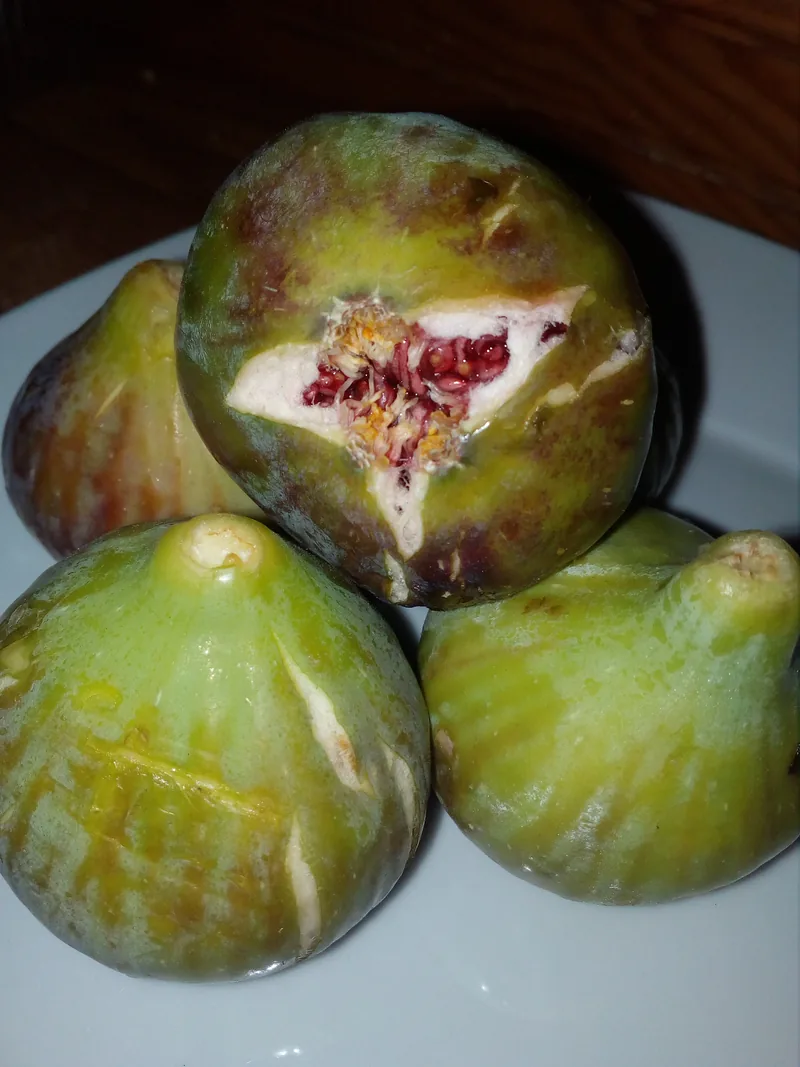
Kew’s edible-fig page, in wording captured on 16 November 2026, says that over 11,000 years ago the fig became “what was probably the first cultivated fruit in human history.” [source]
“Today, more than 1.3 million tonnes of figs are produced worldwide, mostly coming from the ancestral home of the fruit: the Middle East,” the same Kew page says. [source]
“Fig plants were first introduced to Britain during the Roman era, and still grow as ornamentals in parks and gardens across the country.” [source]
The plant belongs, on that Kew page, to the family Moraceae, and its IUCN Red List status is given as Least Concern. [source]
“Fig leaves are around 20 cm long and 14 cm wide, with 3 to 5 deep lobes and rough to the touch.” [source]
“The flowers are very small and contained in a hollow fleshy receptacle that resembles an unripe fig called the synconium.” [source]
“The synconium has a small opening at the apex that allows a fig wasp (Blastophaga psenes) to enter and pollinate the flowers within.” [source]
“The edible fruit consists of the mature syconium containing numerous one-seeded fruits.” The same Kew page uses both spellings, synconium and syconium. [source]
“Mature figs are 3 to 5 cm in diameter, with a green skin, ripening to purple or brown.” [source]
“Fig trees are gynodioecious, meaning they are either female, or hermaphroditic, although only the female tree will produce ripened, edible figs.” [source]
“The sap of the fig plant can cause a skin inflammation if exposed to sunlight in a phenomenon called phytophotodermatitis.” [source]
The native range listed on Kew’s page includes Afghanistan, Cyprus, Greece, Iran, Iraq, Kriti, Lebanon-Syria, North Caucasus, Pakistan, Palestine, Tadzhikistan, Transcaucasus, Turkey, Turkmenistan and West Himalaya. [source]
The introduced range on the same page includes Great Britain, among many others. [source]
Kew gives the best time to see fruits there as August, September and October. [source]
The Royal Horticultural Society’s grow-your-own page, re-opened on 18 November 2026, says the seedless fruits “develop without fertilisation (parthenocarpic fruit), so pollination” is not needed for the figs it is describing. [source]
That RHS page does not mention a fig wasp. [source]
“There are several varieties of fig suitable for cropping in the UK — the best known and most widely available is ‘Brown Turkey’, which has an RHS Recommended: Award of Garden Merit (AGM) so makes a reliable choice.” [source]
The same page also lists LITTLE MISS FIGGY 'Lmf01' as “a compact variety, ideal for containers,” with “sweet, burgundy-coloured figs.” [source]
‘White Marseilles’ is described there as “hardy and reliable with large, sweet, pale green figs.” [source]
‘Brown Turkey’ AGM is also described, in the recommended-varieties list, as “a popular variety for UK gardens. Fruits well.” [source]
“Figs are sold as young potted plants in spring and summer.” For the widest choice, the RHS points gardeners to specialist fruit nurseries and online fruit-tree suppliers. [source]
“Figs need a warm, sunny, sheltered spot to crop well. Spring is the ideal time to plant.” [source]
“Keeping them in a pot is also useful in cooler regions, so they can be moved indoors over winter.” [source]
“In the cool UK climate, figs produce two crops a year, but only the first one usually ripens.” [source]
The first crop “is produced from embryonic figs that start to form in late summer at the branch tips. They stay as pea-size fruitlets until spring, then start into growth and ripen over summer.” [source]
“As the fruitlets form at the shoot tips, they are prone to frost damage, so winter protection is beneficial.” [source]
The second crop “forms on the current season’s shoots later in spring and early summer. These fruit rarely have time to ripen outdoors.” [source]
Those second-crop figs “may reach a reasonable size, but will remain hard and green, so any that are larger than a pea are best removed at the end of summer.” [source]
“Fig trees can also be grown in a greenhouse all year round, where both crops may ripen in a good summer.” [source]
“For the best crop, train your fig tree as a fan against a warm sunny wall and prune twice a year (in spring and early summer) to control the plant’s size and encourage fruiting.” [source]
“Fan-trained figs can be kept to about 1.8m (6ft) tall and 3.5m (11½ft) wide, but can grow bigger if you have more space.” [source]
“In colder locations, figs can be fan-trained in a greenhouse, with the horizontal wires positioned 30cm (1ft) away from the glass.” [source]
“Pinching out shoot tips is a key part of summer fig pruning.” [source]
Twice-yearly pruning, the same page says, “also keeps these vigorous plants at a manageable size and improves fruiting.” [source]
UC Master Gardeners of San Luis Obispo County write: “Figs are not technically fruit but are flask-shaped modified stems encasing numerous tiny flowers.” [source]
“There are hundreds of fig varieties which are classified into four types: Caprifig, Smyrna, San Pedro and Common.” [source]
“Smyrna and San Pedro types require pollination to produce edible fruits; Caprifig type is solely used as a pollinator tree. Common type does not require pollination.” [source]
“Fig pollination is a complex enterprise. It requires a caprifig type fig tree which serves to produce pollen.” [source]
“A fig wasp (Blastophaga) lives part of its life cycle in a caprifig and carries the pollen to other fig trees.” [source]
“Commercial fig growers plant caprifigs in their orchards to promote pollination.” [source]
“Figs from caprifigs are small, dry, nonedible fruit.” [source]
“Home gardeners typically grow the common type of fig tree, the type most commercially available.” [source]
“Some fig trees can produce two crops a year. A breba crop, in early summer, on previous year’s wood requires no pollination.” [source]
“All types produce a main crop, in late summer to early fall, on current season wood.” [source]
On the SLO types list, a caprifig is “for pollination only.” [source]
A Smyrna type “requires pollination, no breba crop,” and is “considered among the best for eating and drying.” “The cultivar most commonly grown here is Calimyrna.” [source]
A San Pedro type “requires pollination for main crop” and “may have a breba crop which does not require pollination.” Common cultivars named for California are King (Desert King), Lampeira, and San Pedro. [source]
A Common type needs “no pollination” and “is most common type found in the home garden. Depending on the cultivar, may have a breba crop.” [source]
Common-type varieties listed for San Luis Obispo County are Adriatic, Black Mission, Brown Turkey, Celeste, Flanders, Italian Everbearing, Osborn’s Prolific, Violette de Bordeaux and White Genoa. [source]
“Figs are large trees, 10–30 feet tall and wide.” They “are deciduous, going dormant in the winter, tolerating temperatures down to 12–15 degrees.” [source]
“To produce the best crop, figs require prolonged summer heat.” [source]
“In coastal areas consider planting next to a south-facing, light-colored wall for increased heat.” They can be espaliered or grown in a large container such as a half wine barrel or 15-gallon container. [source]
“White Genoa variety is a good choice for cool coastal climates with fruit ripening through fall.” [source]
“Plant when trees are dormant. In locations without hard freezes, trees can be planted from fall to early spring.” “Plant in full sun and the warmest location in your yard.” [source]
“Fig trees are not grafted on a rootstock, so plant as usual for a tree at the same depth as in the container.” [source]
“Figs are easily grown from cuttings which are planted once rooted.” [source]
“Figs generally don’t need a lot of water but consistent irrigation is important for young trees. For established trees, water every 1–2 weeks in the summer, depending on soil type and temperature.” [source]
“Water about every three days for potted figs. Apply mulch to retain moisture. Figs will drop their leaves if kept too dry.” [source]
Fertilising, on that page, is “necessary only with sandy soil or potted trees.” “Excess nitrogen promotes excess leaf growth and causes delayed ripening and poor fruit quality.” [source]
“Fig trees are productive with or without pruning.” Pruning can control size and shape and improve air circulation. [source]
The same page says figs are “native to Western Asia and the eastern Mediterranean region,” “cultivated for thousands of years,” and “were first planted in California at the San Diego Mission in 1769.” Those official sentences are kept beside, and not blended with, Kew’s “over 11,000 years ago.” [source]
Phoebe Gordon’s 2026 UCCE talk, read from a copy saved on 16 November 2026, gives the Latin binomial as Ficus carica, and places the plant in the fig family with other food species including breadfruit, jackfruit and mulberry. [UCCE 2026]
The same talk says the Ficus genus “is huge - over 700 species with species-specific pollinators.” [UCCE 2026]
It says the species “has been domesticated since the bronze age,” is “extremely easy to propagate,” “roots readily from cuttings,” and “can be consumed fresh and stored in dried form.” That bronze-age sentence is not treated here as the same claim as Kew’s “over 11,000 years ago.” [UCCE 2026]
Domestication, in that talk, “resulted in: increased fruit size, the development of ‘artificial’ pollination, selection of cultivars that exhibit fruit persistence.” [UCCE 2026]
“Figs are a traditional crop for the Fresno-Madera-Merced area.” “Fresno was founded on fig production as well as raisins.” [UCCE 2026]
“Traditionally production has focused on dried and canned fruit.” “Calimyrna (Sarilop) is the traditional dried variety.” “Kadota (Datatto) was the canned variety.” [UCCE 2026]
The talk distinguishes two crops of edible figs: a breba, or first crop, that “ripens in June (ish)” and is “formed from reproductive buds (immature fruit) that did not complete development in the previous season,” and a main crop that “ripens from August through October” and is formed from buds “produced in season.” [UCCE 2026]
“Syconium (the fig ‘fruit’) are produced at leaf axils as the branch grows.” “Trees can have fruit at all stages of maturity at a single point in time.” [UCCE 2026]
That requires multiple harvests: “Fruit is picked as frequently as every day for fresh harvests.” “Dried fruit is picked up approximately weekly from August – October.” [UCCE 2026]
“The hard ‘seeds’ in figs are actually the fruit – druplets.” [UCCE 2026]
“Wasps survive on ‘caprifigs’ which allow them to successfully reproduce.” “Caprifigs have three crops, which allow multiple generations of fig wasps.” [UCCE 2026]
“The second crop of the caprifig (profichi) coincides with when the main crop needs to be pollinated.” [UCCE 2026]
There are four types in that talk. Smyrna “requires pollination to set any fruit; bears no breba/first crop.” [UCCE 2026]
San Pedro “does not require pollination for the breba, requires pollination for the main crop.” [UCCE 2026]
Common / Persistent “does not require pollination for either crop, does not always produce breba.” [UCCE 2026]
A caprifig is “mostly inedible. Functionally male, and where the fig wasp completes its life cycle.” [UCCE 2026]
Later in the same talk comes the sentence “Wasp pollination is obsolete in California production systems.” This site quotes that as a note about current orchards, not as a claim that Smyrna-type figs no longer need pollination. [UCCE 2026]
Reasons given there include that “Calimyrna (Sarilop) doesn’t yield as well as other cultivars,” and that “the fig wasp introduces endosepsis into fruit – formerly a serious disease of fruit.” [UCCE 2026]
“Weedy figs used to be culled to reduce the chance of wild fig wasps” reaching the crop, in the same official list of notes about those production systems. [UCCE 2026]
Kew’s edible fruit is “the mature syconium containing numerous one-seeded fruits.” UC Master Gardeners of San Luis Obispo County say figs “are not technically fruit but are flask-shaped modified stems encasing numerous tiny flowers.” Both official ways of speaking are kept. [source]
RHS UK garden figs are parthenocarpic. UC Common types, including Brown Turkey in the San Luis Obispo list, “do not require pollination.” UC Smyrna types still “require pollination to set any fruit.” Those official sentences are not flattened into one rule for every fig. [source]
The wasp on Kew’s page is named Blastophaga psenes. The wasp on the San Luis Obispo page is named Blastophaga. This desk keeps both official namings. [source]
A typographic fact sheet on this site may repeat official wording; the CC BY-SA photographs are not placed inside those sheets. [source]
Kew’s wording used here was captured on 16 November 2026. The live Kew page returned HTTP 403 on 18 November 2026, and is not extended from memory. [source]
The RHS grow-your-own page was re-opened and read again on 18 November 2026. [source]
The UC San Luis Obispo figs page and the UCCE 2026 talk were read from copies saved on 16 November 2026. A live public URL for the talk was not re-opened on 18 November 2026. [source]
Rob Hille’s 4 August 2009 photograph of Ficus carica fruit and leaves is in the public domain, and is not labelled as a horticultural type. [source]
Forest and Kim Starr’s 3 August 2009 Wailuku photograph of Ficus carica fruit and leaves includes figs whose apical opening can be seen. [source]
Ivar Leidus’s halved common fig, grown in Brazil and dated 4 February 2022, is CC BY-SA 4.0 and is used on the website only. [source]
Enjoyed this desk of official figs, wasps, and four horticultural types?
No pop-ups. No intrusive advertising. Just interesting stuff. A little support helps the next fruits.im site get built.