Home · Questions
Questions
Questions a curious reader actually asks
The answers below stay with official wording. Where two official pages disagree, the disagreement is the answer.
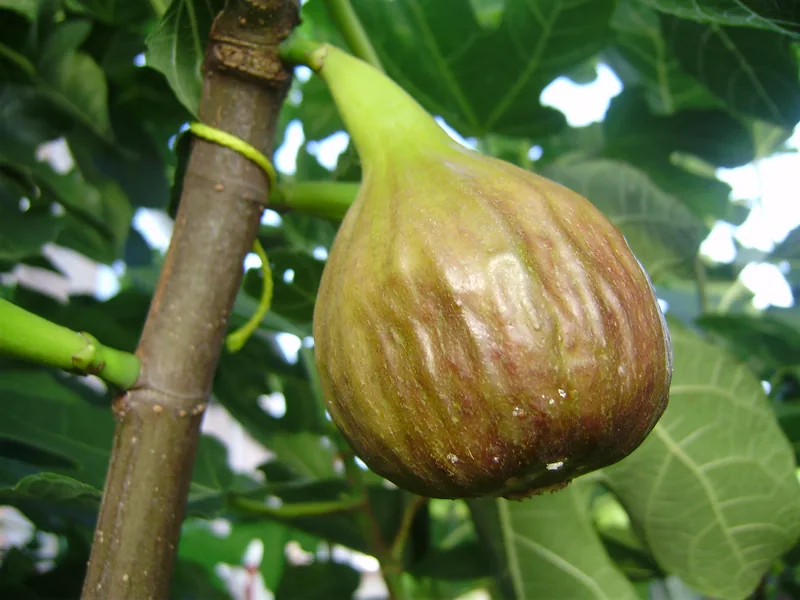
Does a fig need a wasp?
It depends which official page you are on. Kew describes a fig wasp, Blastophaga psenes, entering a small opening at the apex to pollinate the flowers inside the synconium. [source] The RHS, writing about UK garden figs, says the seedless fruits are parthenocarpic, so pollination is not needed. [source] A University of California list then divides figs into four types, only some of which need pollination. The wasp desk keeps those answers on separate buttons.
What is actually inside a fig?
Kew: very small flowers in a hollow fleshy receptacle, and an edible fruit that is the mature syconium containing numerous one-seeded fruits. [source] UC Master Gardeners of San Luis Obispo County: “not technically fruit but… flask-shaped modified stems encasing numerous tiny flowers.” [source] A 2026 UCCE talk: the hard “seeds” “are actually the fruit – druplets.” [UCCE 2026]
Will a ‘Brown Turkey’ in a UK garden need a caprifig?
Not according to the official pages this desk uses. The RHS describes those garden figs as parthenocarpic. [source] Brown Turkey also appears on the San Luis Obispo Common-type list, and Common types “do not require pollination.” [source]
Why did my second crop stay hard and green?
In the cool UK climate, the RHS says figs produce two crops a year, “but only the first one usually ripens.” The second crop “rarely [has] time to ripen outdoors” and “will remain hard and green,” so any fruits “larger than a pea are best removed at the end of summer.” [source] In a greenhouse kept all year, “both crops may ripen in a good summer.” [source]
Are caprifigs worth eating?
The San Luis Obispo page calls their figs “small, dry, nonedible fruit.” [source] Gordon’s talk calls a caprifig “mostly inedible” and “functionally male.” [UCCE 2026] Its official job, in both sources, is pollination.
Is fig sap dangerous?
Kew says it “can cause a skin inflammation if exposed to sunlight in a phenomenon called phytophotodermatitis.” [source] This site repeats that official caution and does not offer medical advice. See sap, sunlight and leaves.
How long have people grown figs?
Kew: “over 11,000 years ago,” and “probably the first cultivated fruit in human history.” [source] A 2026 UCCE talk: “domesticated since the bronze age.” [UCCE 2026] UC Master Gardeners: “cultivated for thousands of years,” and first planted in California at the San Diego Mission in 1769. [source] Those official clocks are kept apart on the history page.
When can I see figs at Kew?
The captured Kew page gives the best time to see fruits there as August, September and October. [source] The live page could not be re-opened on 18 November 2026.
Do you sell paid kits, or a wasp?
No. The shop has free typographic fact sheets, a link to the ReallyByte shop on printables.im, Amazon searches, and a birthday card. There are no paid kits, and this desk does not sell insects.
Enjoyed this desk of official figs, wasps, and four horticultural types?
No pop-ups. No intrusive advertising. Just interesting stuff. A little support helps the next fruits.im site get built.